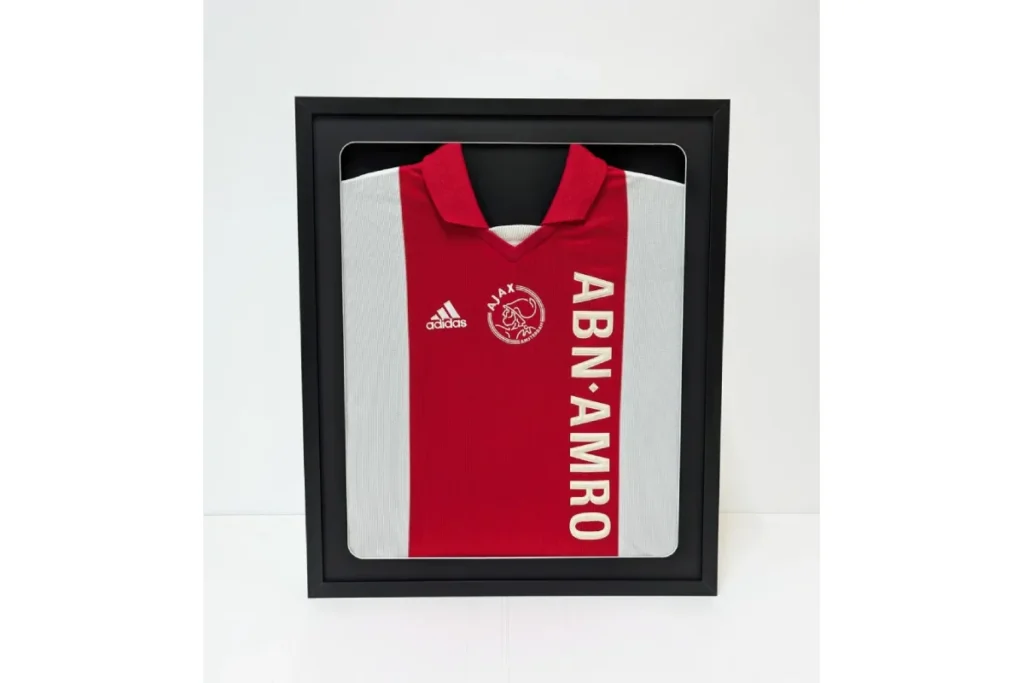

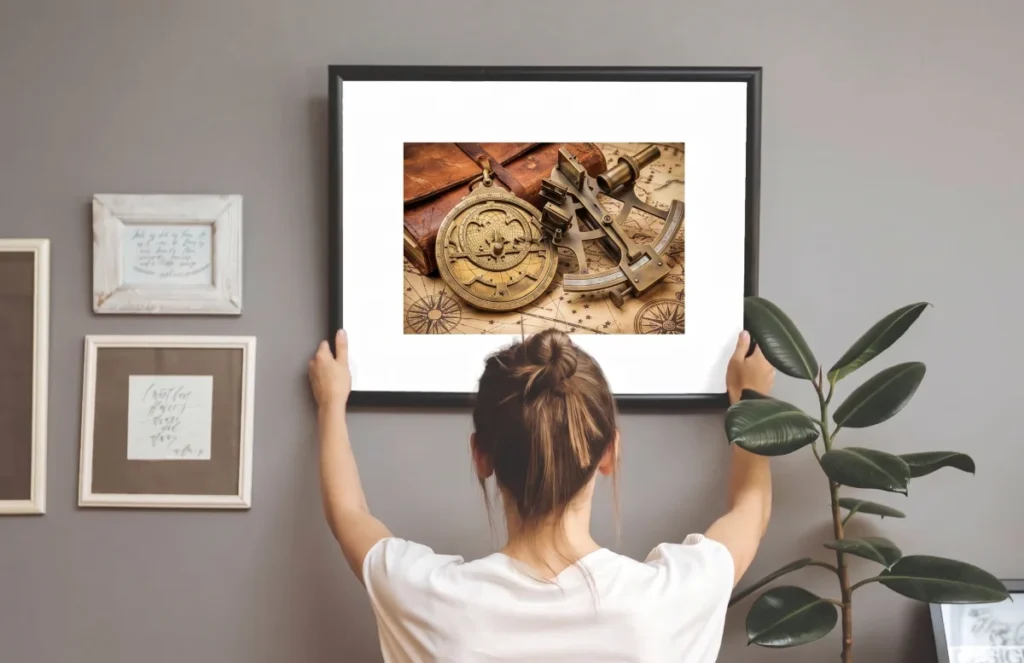
When choosing a frame, attention usually focuses on the profile, the colour and the mount. There is, however, another equally important element that is often considered only at the end: the glass.
Glass does not simply protect the artwork from dust. It can significantly affect the perception of colours, the amount of light reaching the image, the presence of reflections and, above all, the level of protection provided to the artwork over time.
For this reason, there is no single type of glass suitable for every framing project. A photograph, a work on paper, a painting, a document, a three-dimensional object or a large frame may require completely different solutions.
In our workshop, we use different types of glass and transparent materials, selecting them according to the project.
Standard Glass: A Simple and Versatile Solution
Standard glass is the traditional and simplest solution for framing.
It is transparent, protects the artwork from dust and external agents, and is suitable for many images, photographs, prints and decorative pieces where special anti-reflective or UV protection performance is not required.
Its main limitation is the one we all know: it reflects light.
A window, lamp or light source positioned in front of the frame can create reflections that interfere with viewing the artwork.
For this reason, when lighting conditions are particularly important or when a clearer view is desired, it may be worth choosing extra-clear or anti-reflective glass.
Extra-clear glass is characterised by greater colour neutrality compared with standard float glass.
The difference can be particularly noticeable when framing light colours, photographs, images with a large amount of white or artworks where it is important to maintain the most faithful possible colour perception.
It is an interesting choice when the main goal is transparency and colour rendition, without necessarily requiring the performance of anti-reflective glass.
UltraVue 70: When You Want to See the Artwork, Not the Reflection
UltraVue UV70 is an extra-clear glass with an anti-reflective treatment and up to 70% UV protection.
The anti-reflective treatment drastically reduces reflections and allows the artwork to be viewed more clearly, even in environments where lighting could otherwise cause problems.
The glass also uses an extra-clear base designed to maintain very high light transmission and clean colour rendition. Tru Vue states that UltraVue UV70 provides light transmission of more than 98.5% and filters up to 70% of UV rays.
It is a highly versatile solution for photographs, prints, graphic works and projects where visual quality needs to be superior to that of traditional glass, without necessarily requiring museum-level UV protection.
ZeroGlass 70: Almost Invisible Glass
ZeroGlass 70 belongs to the category of high-transparency anti-reflective glass.
It is a low-iron glass, making it highly neutral in terms of colour, with an anti-reflective treatment on its surfaces. The specifications stated for ZeroGlass UV70 include visible reflection of less than 0.5%, light transmission of more than 99% and UV protection above 70%.
The result is a type of glass that tends to become almost imperceptible once installed.
It is particularly interesting when the goal is maximum clarity, clean colours and extremely low reflections, while still providing greater UV protection than ordinary glass.
Museum 99: When Conservation Is a Priority
When an artwork has particular artistic, historical or sentimental value, protection from the ultraviolet component of light becomes an important factor to consider.
Glass with 99% UV protection can significantly reduce the artwork’s exposure to UV rays, helping to slow down light-related processes of deterioration and fading.
It is particularly suitable for works on paper, photographs, art prints, documents and materials for which long-term conservation is a priority.
This category includes museum-type glass with 99% UV protection, also available with anti-reflective and high-transparency characteristics.
The term “99” does not mean that an artwork can be exposed to light without consequences: UV protection is only one element of conservation. The intensity and duration of light exposure, temperature, humidity and framing methods also play an important role.
Optium: A High-End Acrylic Solution
Optium Museum Acrylic is completely different from traditional glass: it is an acrylic material designed for high-quality conservation applications.
It combines several characteristics that are difficult to achieve simultaneously:
up to 99% UV protection;
anti-reflective treatment;
high light transmission;
anti-static properties;
high scratch resistance;
impact and shatter resistance;
lower weight than glass.
Tru Vue states that Optium has less than 1.6% reflection, more than 98% light transmission and up to 99% UV protection. Optium Museum Acrylic is also anti-static and features an abrasion-resistant surface treatment.
It is particularly interesting for large-format artworks, valuable works, materials sensitive to electrostatic charge, public environments and situations where safety and lightness are important.
Unlike glass, acrylic does not present the same risk of breakage and can therefore be particularly useful when a traditional glass sheet would be too heavy or unsafe.
Crilex: Lightweight and Safe
Crilex is a transparent acrylic material used when safety and lightness become important elements of the project.
Compared with traditional glass, it is much lighter and does not present the typical shattering risk associated with a glass sheet.
For this reason, it is particularly suitable for:
large formats;
frames intended for shipping;
environments where the risk of impact is greater;
temporary exhibitions;
objects and memorabilia;
projects where the weight of the frame needs to be kept under control.
It is also particularly interesting for our sports jersey and sports memorabilia frames, where safety, weight and impact resistance can be important considerations.
Scratch-Resistant Plexiglass: When Lightness and Practicality Matter
Scratch-resistant plexiglass is another acrylic solution designed to combine lightness and resistance.
Compared with standard plexiglass, its scratch-resistant surface treatment makes it more suitable for situations where the material needs to be cleaned frequently or may be more exposed to contact.
It is an interesting solution for large dimensions, public environments, contemporary spaces and projects where safety and lightness are more important than choosing traditional glass.
Silvered Mirror: When the Reflective Surface Becomes Part of the Design
Not every frame necessarily has to contain an image.
Silvered mirror allows the frame to be used as a decorative and design element, transforming it into a true reflective surface.
The choice of frame, dimensions, proportions and mirror finish can create very different compositions: from simple contemporary solutions to more decorative projects.
In this case, the frame does not simply protect something being displayed, but becomes an integral part of the interior design.
Which Glass Should You Choose?
The choice should always start with the artwork and the environment, not with the name of the glass.
The main differences can be summarised as follows:
| Solution | Main strength | When to choose it |
|---|---|---|
| Standard glass | Simplicity and affordability | Standard framing |
| Extra-clear glass | Neutrality and brightness | When colour rendition is important |
| UltraVue 70 | Anti-reflective + UV 70 | Works requiring good visibility and protection |
| ZeroGlass 70 | High transparency + anti-reflective + UV 70 | When you want almost invisible glass |
| Museum 99 | 99% UV protection | Light-sensitive works and conservation framing |
| Optium | 99% UV + anti-reflective + lightness + safety | Valuable works, large formats and special situations |
| Crilex | Lightness and shatter resistance | Large formats, shipping, objects and memorabilia |
| Scratch-resistant plexiglass | Lightness + greater surface resistance | Practical projects and large dimensions |
| Silvered mirror | Reflective surface | Decorative and interior-design projects |
Naturally, this table is only a starting point: two artworks of the same size may require completely different types of glass.
Anti-Reflective and UV Protection Are Not the Same Thing
This is an important distinction.
Glass can be anti-reflective without offering particularly high UV protection, or it can provide strong UV protection without being designed to eliminate reflections.
They are therefore two different characteristics:
Anti-reflective → improves the way the artwork is viewed.
UV protection → contributes to the conservation of light-sensitive materials.
The most advanced solutions can combine both characteristics, reaching 99% UV protection and very low reflection levels.
The Right Glass Is Part of the Framing Project
The choice of glass should not be the last detail to decide.
When we design a frame, we consider the artwork, mount, framing method, profile, environment, lighting, dimensions and intended use together.
A painting hung in a dimly lit room may have completely different requirements from a photograph displayed in front of a large window. An art print may require particular attention to conservation, while a large piece of sports memorabilia may make a lightweight and shatter-resistant material preferable.
For this reason, our workshop offers a range of solutions: from standard glass to extra-clear and anti-reflective versions, as well as glass with high UV protection and professional-grade acrylic materials.
We don’t simply choose a glass. We study which level of protection and visual performance is best suited to what needs to be framed.
Come and Visit Our Workshop
The difference between one type of glass and another is much easier to understand when you can compare them directly.
In our workshop, we can show you the different solutions and assess transparency, reflections, colour rendition, protection, weight and safety together, choosing the material best suited to the project.
Because glass, just like the frame, is part of the way an artwork is seen and preserved.
Roberto Risso
Corniciaio
I like combining the knowledge and experience of the workshop, the care of handmade craftsmanship, and the new possibilities offered by technology, to find the most suitable solution for everything I frame.